
On this page
- Which guards work under pines and hardwoods?
- Do guards cope with Cumming's downpours?
- What do guards not fix?
- What else do guards help with?
- How long do guards last?
- Should guards go on new gutters or old ones?
- How are guards installed?
- Do guards suit every roof?
- What do guards cost to maintain?
- Which guard for which roof edge?
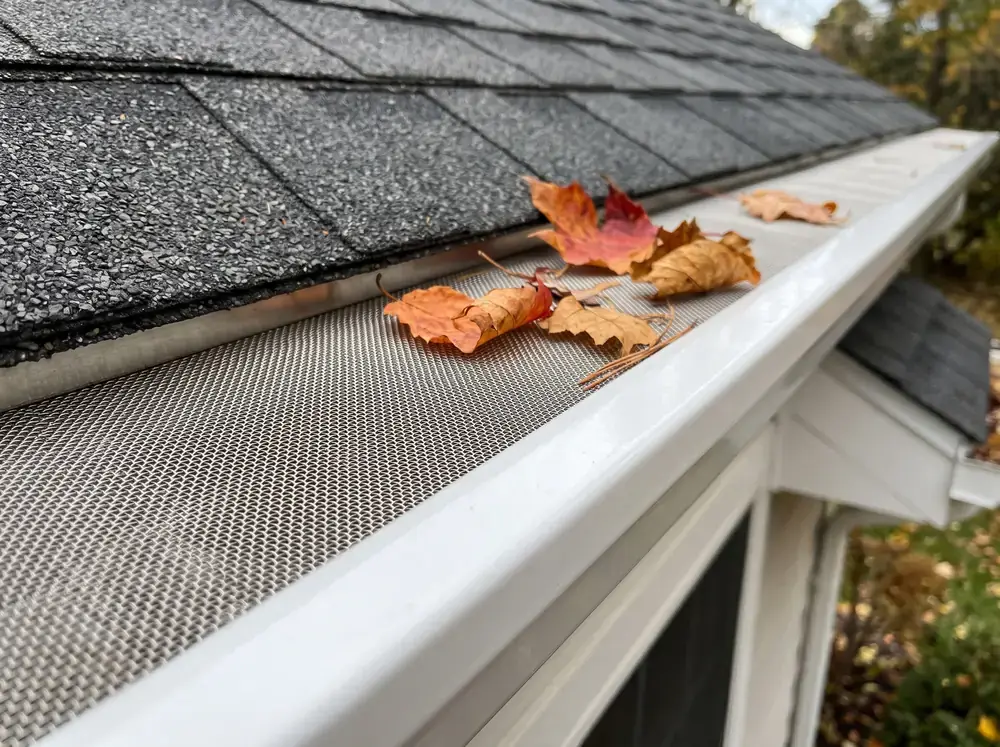
Which guards work under pines and hardwoods?
The ones with the finest openings. Forsyth County lots often carry tall pines with oaks, sweetgums and maples under them, so a gutter here sees a mix: long needles most of the year, pollen and catkins in spring, and broad leaves in late autumn. A guard that stops a maple leaf but lets a pine needle through will still clog. Call (470) 839-3794 and an independent contractor can look at what is overhead and suggest a guard.
| Guard | What it stops | Weak spots |
|---|---|---|
| Stainless micro-mesh | Needles, leaves, seeds, most grit | Costs more; fine mesh needs an occasional brush |
| Perforated metal cover | Leaves, most seeds | Needles can thread through larger holes |
| Screen | Large leaves | Needles and catkins pass through and jam outlets |
| Reverse curve (surface tension) | Leaves | Can shed water over the front in hard rain |
| Foam or brush inserts | Some leaves | Hold debris and water; break down in the heat |
Do guards cope with Cumming's downpours?
That is the question to ask. A guard sits on top of the water path, so in a short, intense storm it has to let water in as fast as the roof delivers it. NOAA's rainfall atlas gives a 10-year, five-minute burst near Cumming of about 7.98 inches an hour. A clean, fine micro-mesh usually passes that well. A mesh coated in pollen or a reverse-curve guard on a steep roof may send some water over the front. Ask the contractor what flow rate the product is rated for, and make sure the gutter underneath is big enough for the roof.
What do guards not fix?
- An undersized gutter. If a 5-inch run spills in a clean state, a guard will not change that. Upsize the run or add downspouts first.
- A lost pitch or sag. Fix hangers and pitch before guards go on.
- Pollen. Fine mesh keeps most of it out, but some silt washes through and needs flushing.
- Downspout problems. A clogged elbow or a buried line full of roots still needs clearing.
- The roof itself. Debris that builds up on the roof above the guard, in valleys and behind chimneys, still needs clearing.
What else do guards help with?
Mosquitoes. The Georgia Department of Public Health asks residents to clean out gutters as part of removing standing water where mosquitoes breed, and UGA Extension lists gutters and drainage systems among typical breeding sites. A guard that keeps debris out helps gutters drain dry between storms.
Termites and wood rot. UGA Extension notes that subterranean termites can draw moisture from rain gutters and other wet spots on a house. Gutters that drain freely keep fascia and soffits drier.
Ladder time. Fewer climbs onto a two-storey roof or over a walk-out basement is a real benefit, especially on steep lake lots.
How long do guards last?
Stainless mesh in an aluminum frame typically lasts as long as the gutter under it. Plastic screens and foam inserts break down faster in Georgia sun and heat. Ask for the product name, the warranty terms in writing, and whether the warranty requires periodic cleaning.
Should guards go on new gutters or old ones?
New gutters are the easiest time, because the guard can be matched to the gutter and the hangers. Existing gutters can take guards if they are sound, pitched and well hung. If the gutters will need replacing within a few years, it may be better to do both together. See are gutter guards worth it? and pine needles, pollen and gutters.
How are guards installed?
Most guards fix to the front lip of the gutter and either rest against the roof edge or slide under the first course of shingles. The installer should first clean the gutter, fix sags, reseal leaking corners and check the pitch, because the guard makes the gutter harder to get into later. Ask how the guard meets the roof and whether that affects the shingle warranty.
Do guards suit every roof?
Not every one. Very steep roofs and metal roofs shed water fast, which can push water over some guard designs. Tile and slate roofs need guards that do not disturb the roofing. On those roofs, ask for a product made for that roof type.
What do guards cost to maintain?
Less than cleaning open gutters, but not nothing. Plan on checking guards after the spring pollen and the autumn leaves, brushing mesh that looks coated, clearing valleys above the guard, and flushing the gutter every year or two. Ask whether the warranty requires any of this.
Which guard for which roof edge?
| Roof edge | Guard to ask about |
|---|---|
| Architectural shingles | Micro-mesh that fixes to the gutter lip, or slides under the first course if the shingle warranty allows |
| Metal roof | A guard rated for fast runoff, fixed to the gutter rather than the panels |
| Low-slope porch roof | Perforated cover or mesh; water moves slowly so overshoot is rare |
| Copper half-round | A copper or stainless mesh made for half-round |