
On this page
- When does a house need 6-inch gutters?
- How do the numbers work?
- What does that mean for a typical Forsyth County home?
- Where do 6-inch gutters matter most?
- What else has to change with the gutter?
- What does upsizing cost?
- Do 6-inch gutters need different hangers?
- Can existing hangers be reused when upsizing?
- How do 6-inch gutters look on a ranch?
When does a house need 6-inch gutters?
When a roof plane sends more water to a run than a 5-inch gutter can carry in a hard burst. Around Cumming that happens more often than in many parts of the country, because the design storm is intense. Call (470) 839-3794 and an independent contractor can measure your roof and say which runs need upsizing.
How do the numbers work?
The This Old House method multiplies the roof area draining to a gutter by a pitch factor and by the region's five-minute rainfall intensity, then compares the result to each gutter's rated capacity. NOAA's rainfall atlas gives a 10-year, five-minute intensity near Cumming of about 7.98 inches an hour.
| Gutter | Rated capacity (adjusted sq ft) | Roof area per run at 7.98 in/hr, 6/12 pitch |
|---|---|---|
| 5-inch K-style | 5,520 | about 630 sq ft |
| 6-inch K-style | 7,960 | about 905 sq ft |
| 5-inch half-round | 2,500 | about 285 sq ft |
| 6-inch half-round | 3,840 | about 440 sq ft |
Steeper roofs shed water faster, so the pitch factor rises: 1.2 for 9/12 to 11/12, and 1.3 for 12/12 and up. On a steep 10/12 roof, a 6-inch K-style run serves about 830 square feet. The figures assume properly sized downspouts about every 40 feet.
What does that mean for a typical Forsyth County home?
A large two-storey home with a 2,600 square-foot footprint might have a rear roof plane of 900 to 1,400 square feet. By these figures, that plane is at or beyond what one 6-inch run can carry from a single outlet. The answer is rarely an even bigger gutter. It is usually a 6-inch gutter drained from both ends, with 3x4 downspouts, so each half of the run handles half the roof.
A small front porch roof or a garage eave of 200 to 400 square feet is well within a 5-inch gutter's reach. That is why mixed systems are common.
Where do 6-inch gutters matter most?
- Below valleys. Two roof planes meet and pour into one spot. The corner below takes far more water than the rest of the run.
- Long rear runs. Back elevations on walk-out basement homes are often the biggest roof planes.
- Steep roofs. Water arrives faster and can overshoot a small gutter.
- Under pines. A bigger trough and a bigger outlet take longer to block.
- Metal roofs. Water and debris slide off fast.
What else has to change with the gutter?
- Downspouts. Pair 6-inch gutters with 3x4 inch downspouts, which the TOH guide rates at about 1,200 square feet against 600 for 2x3.
- Outlets. A larger outlet, or a funnel-shaped outlet, lets water and debris leave faster.
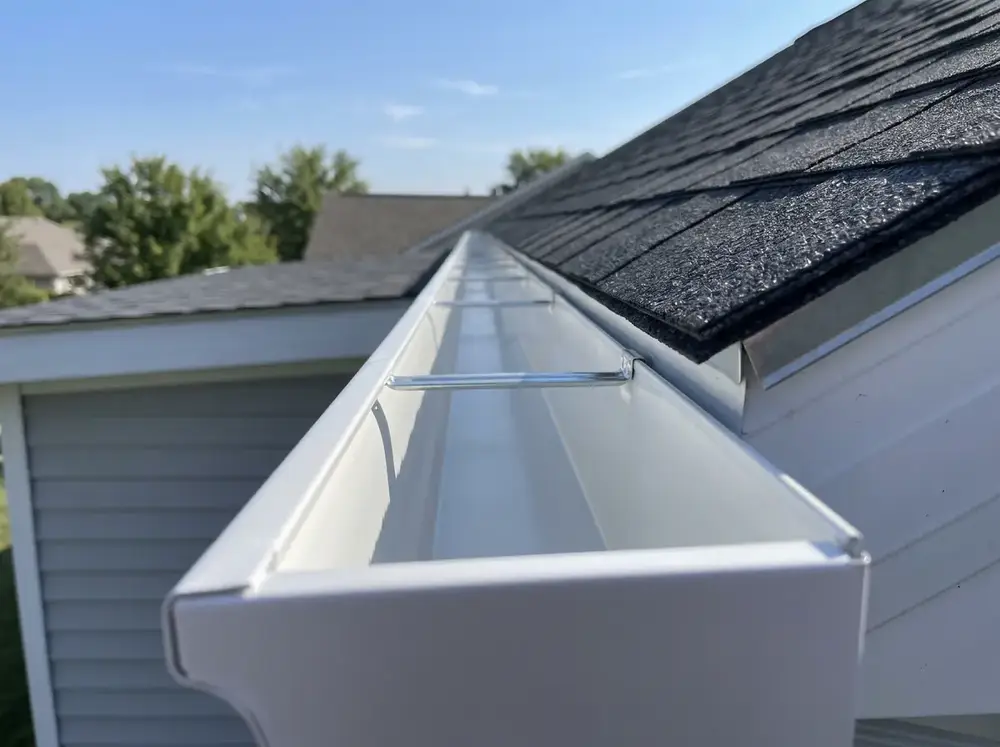
- Hangers. A 6-inch gutter full of water is heavier, so hanger spacing matters.
- Guards. If guards are planned, choose ones made for 6-inch gutters.
What does upsizing cost?
National guides put 6-inch seamless aluminum at about $11 to $17 a foot installed, against $9 to $14 for 5-inch. Upsizing only the runs that need it keeps the difference down. See 5-inch vs 6-inch gutters.
Do 6-inch gutters need different hangers?
The same hidden hanger types are made in 6-inch sizes. Because a full 6-inch gutter is heavier, close spacing matters more. Ask for the spacing in writing.
Can existing hangers be reused when upsizing?
No. Hangers are made for a specific gutter size, so upsizing from 5-inch to 6-inch means new hangers along with the new gutter. It is a good moment to tighten the spacing too.
How do 6-inch gutters look on a ranch?
On a single-storey ranch with modest roof planes, 6-inch gutters can look heavy. If the numbers allow, 5-inch with downspouts at both ends of long runs keeps the proportions right.